Media Center
Challenging the World. The New Standard for Cables.
Challenging the World. The New Standard for Cables.
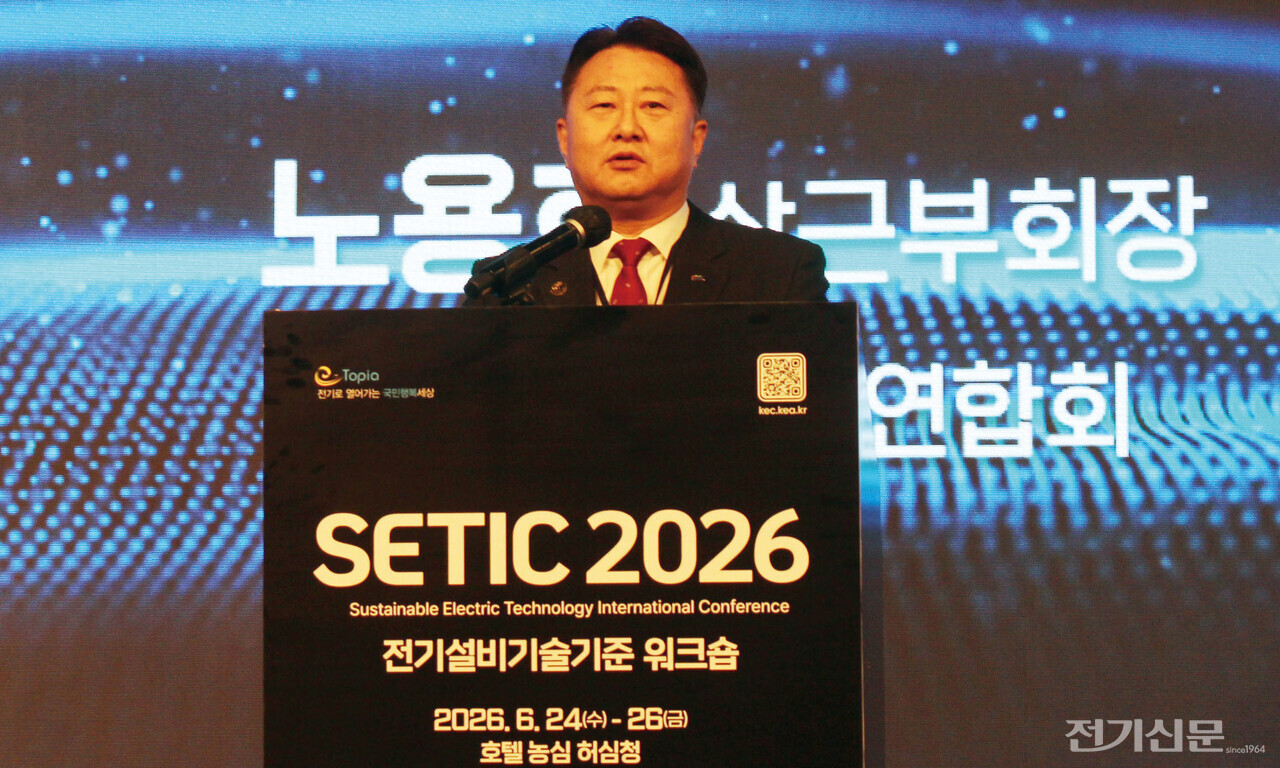
BUSAN, South Korea — "The role of electrical installation safety standards is becoming increasingly critical to ensure a stable power supply and electrical safety," said Noh Yong-ho, Vice Chairman of the Korea Electrical Industry Federation (KEIF), on the 24th. "At SETIC 2026, let us collectively address core issues across the power sector, including the KEC (Korea Electrotechnical Code) technical seminars, future power grids, and grid stabilization technologies."
Speaking at the opening ceremony of SETIC 2026 held at Hotel Nongshim in Busan, Vice Chairman Noh noted, "On June 17, Busan was selected as South Korea's first candidate site for commercial Small Modular Reactors (SMRs). Holding SETIC 2026 here in Busan, where groundbreaking shifts and innovations in the energy industry are taking place, carries profound significance."
The Sustainable Electric Technology International Conference (SETIC 2026), which began in 2003, marks its 24th anniversary this year. Over the course of three days ending on the 26th, electrical and energy experts will share knowledge and insights to map out the future development of the electrical industry.
Vice Chairman Noh emphasized, "Newly launched under the Framework Act on the Development of the Electrical Industry, the Federation will communicate even more closely with the sector, fulfilling its responsibilities to safeguard electrical facilities and back the growth of the industry."
During the event, Kim Jun-han, a manager at Korea Electric Power Corporation (KEPCO), and other recipients were honored with ministerial commendations from the Ministry of Climate, Energy, and Environment for their contributions to energy industry development.
On the opening day, the Technical Seminar on Electrical Fire Prevention introduced future directions for Arc Fault Circuit Interrupter (AFCI) installation standards and real-time monitoring systems for distribution boards in traditional markets. Simultaneously, the Carnot Battery Technical Seminar covered R&D projects focused on integrated Carnot battery systems. A Carnot battery is a large-scale, Long-Duration Energy Storage (LDES) technology that converts surplus electricity into thermal energy, stores it in materials like concrete, and converts it back into electricity via steam turbines when needed.
At the opening event, Kim Chang-sub, Chairman of the Electricity Regulatory Commission, delivered a special lecture titled "The Past and Future of Power Regulation."
He began by noting that the power industry is facing a massive energy transition, forecasting a sweeping overhaul of the current power oversight structure. As the expansion of renewable energy and a surge in market participants expose the limitations of the existing framework, Chairman Kim proposed a new governance model centered on the creation of a "Korea Power Supervisory Agency" (tentative name).
South Korea's power industry has evolved from a vertically integrated monopoly into a unbundled generation system. However, to meet the national target of a renewable energy generation share of over 20% and a capacity of 100 GW by 2030, current facilities must expand by approximately 2.7 times. Furthermore, the number of member companies in the Korea Power Exchange (KPX) has skyrocketed from 19 in 2001 to over 7,000 last year, making the market environment highly complex.
With inverter-based renewable energy sources rising, grid instability is worsening. Consequently, relying solely on conventional, ex-post, and centralized oversight has clear limits in preventing large-scale grid blackouts.
As a solution, Chairman Kim proposed a "Three-Way Separation" framework dividing policy, deliberation, and oversight:
Policy Design: Handled by the Ministry of Climate, Energy, and Environment.
Final Deliberation & Resolution: Overseen by the Electricity Regulatory Commission.
Market Monitoring & Grid Oversight: Managed by the newly established Power Supervisory Agency.
This structure adapts the collaborative model of the Financial Services Commission (FSC) and the Financial Supervisory Service (FSS) to the electricity market, aiming to boost regulatory expertise and efficacy through the complementary roles of the decision-making body and the executive arm.
The primary mandates of the proposed Power Supervisory Agency include:
Timely updates to the Grid Code
Eliminating governance time-lags
Objective verification of emergency measures, such as curtailment and maintenance scheduling
Closing regulatory blind spots
Data-driven, high-precision market surveillance
To realize this, he highlighted that anchoring the legal basis in the Electricity Utility Act to guarantee institutional independence, securing financial autonomy through industry levies, and building AI-driven big data analytics capabilities will be critical to success.
"Structures can be changed quickly, but operational capabilities cannot be built overnight," Chairman Kim stressed, highlighting a phased implementation plan targeting a transition period in 2026 and an official launch in 2027. "Establishing the Power Supervisory Agency is not merely about adding another public institution; it is about building a robust institutional shield to safeguard industrial growth and public life within a shifting power market."
Source: Electric Times (https://www.electimes.com) June 24, 2026, 17:42
